The Ghost in the Score: Why We Are Obsessed with Imperfect Audio
In an era of AI-generated sonic perfection, the cultural elite is turning toward the 'crackling' rituals of high-fidelity analog and the beauty of human error.
The Silence of the Algorithm
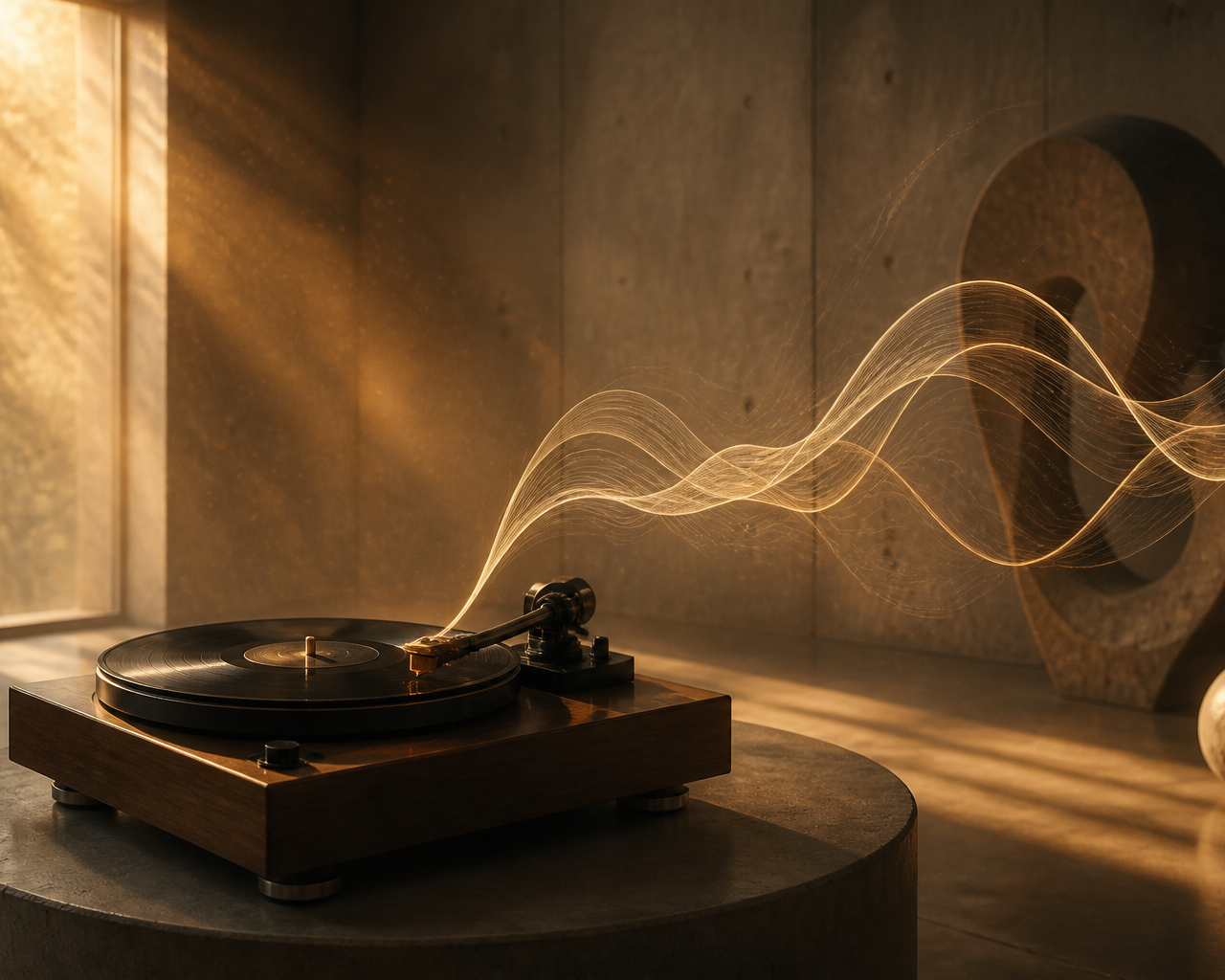
There is a specific, haunting quiet that occurs two seconds before a needle drops onto a 180-gram vinyl record. It is not the total, clinical silence of a Spotify stream or a lossless FLAC file. It is a 'charged' silence—a textured, expectant atmosphere composed of microscopic dust motes and the physical friction of a diamond tip meeting a groove. This is what record producers call the noise floor, and in 2024, it has become the most sought-after commodity in the global cultural landscape.
For the last three decades, the trajectory of audio engineering has been a relentless march toward the elimination of 'error.' Through Digital Audio Workstations (DAWs) and generative AI tools, we have achieved a state of sonic transparency where every frequency is quantized and every rhythm is perfectly gridded to the millisecond. Yet, as perfection became the baseline, a strange thing happened: we began to miss the ghosts.
Today’s cultural vanguard is rejecting the sterile 'cleanliness' of digital audio in favor of Lofi aesthetics, tube amplification, and the deliberate preservation of technical 'flaws.' From the resurgence of Japanese-style 'Listening Bars' (Jazz Kissa) in London and Brooklyn to the skyrocketing prices of vintage Nagra tape recorders, we are witnessing a ritualistic return to the tactile.
Why is Analog Sound Returning to the Cultural Mainstream?
To understand this shift, we must look at the psychological concept of Digital Fatigue. In a world where music is invisible, infinite, and ephemeral, the act of physical playback becomes a grounding ritual. It is a rebellion against the 'convenience economy.'
The Hierarchy of Listening Experiences
Modern listeners are increasingly distinguishing between 'background consumption' (streaming) and 'intentional audition' (analog). This distinction is reflected in how we design our living spaces and our social lives. The following table compares the two primary modes of modern sonic engagement:
| Feature | Digital Streaming | Analog/High-Fidelity Ritual |
|---|---|---|
| Engagement Mode | Passive / Multitasking | Active / Linear |
| Physicality | Non-existent (Cloud) | Tactile (Sleeve, Needle, Dial) |
| Aesthetic Value | High Convenience | High 'Wabi-sabi' (Imperfection) |
| Economic Model | Access/Subscription | Ownership/Curation |
| Social Aspect | Algorithmic Isolation | Shared Listening Spaces |
"The crackle of a record isn't a defect; it's the signature of a physical object occupying space and time with you. It’s the sound of reality."
The Rise of the 'Listening Bar'
Originally a staple of post-war Tokyo, the Jazz Kissa—a cafe dedicated specifically to high-end audio and concentrated listening—has become the blueprint for high-end hospitality in Western capitals. Establishments like Spiritland in London or Public Records in New York treat sound systems not as background noise, but as the central altar of the space.
This growth indicates a pivot toward 'Slow Culture.' Much like the artisanal coffee movement or the 'slow food' revolution, high-fidelity audio demands a sacrifice of time and effort. You cannot 'skip' a track on a turntable without physical intervention. This friction is the point. It forces the listener into a state of presence that the skip button has essentially destroyed.
The Science of 'Warmth': Why Our Brains Crave Distortion
Audiophiles often speak of the 'warmth' of analog gear. This isn't just poetic fluff; it is rooted in physics. Digital clipping creates harsh, odd-order harmonics that the human ear perceives as abrasive. Conversely, vacuum tubes and magnetic tape create even-order harmonic distortion. This mimics the natural overtones found in acoustic instruments and the human voice.
Comparing Sonic Profiles
| Technical Attribute | Digital (PCM/DSD) | Analog (Vinyl/Tape) |
|---|---|---|
| Signal Path | Discrete (0s and 1s) | Continuous Waveform |
| Harmonic Profile | Linear/Transparent | Even-Order Harmonic 'Warmth' |
| Dynamic Range | Theoretically Infinite | Naturally Compressed |
| Aging Process | Perfect until Corrupted | Graceful Degradation (Patina) |
The 'Tape Saturation' Paradox in Modern Production
In a delicious irony, even the most modern pop stars—from Billie Eilish to Kendrick Lamar—regularly use digital plugins to re-introduce the sounds of failing equipment. They simulate tape hiss, wow and flutter, and bit-crushing to make their digital tracks feel 'real.'
We are living in an era of Simulated Nostalgia. Because we have lost the physical connection to the media we consume, we are desperate to re-inject the artifacts of physicality back into the stream.
"We aren't just buying records; we are buying a sense of permanence in a world that feels increasingly like a simulation."
Is the High-Fidelity Movement Elitist?
Critics argue that the $50,000 turntable setups found in minimalist lofts represent a new form of class signaling. While any hobby can become a 'gear race,' the core of the movement is actually quite democratic. The 'Lofi Girl' YouTube phenomenon, which has billions of views, centers on low-fidelity, dusty, and 'imperfect' beats produced by bedrooms artists using cheap gear. The appeal is the same: a rejection of the high-gloss, hyper-processed corporate sound.
FAQ: Understanding the Cultural Shift in Sound
What is meant by 'High-Fidelity' in a cultural context?
Beyond technical specs, it refers to a philosophy of listening that prioritizes the artist's original intent and the physical medium over the convenience of a digital file.
Why is vinyl still popular despite its flaws?
Vinyl is popular precisely because of its flaws. The physical limitations of the medium—the 'rumble' and the 'hiss'—provide a sensory anchor that digital files lack, making the music feel like an object rather than a data point.
Are listening bars just for audiophiles?
No, they are primarily social spaces that prioritize 'deep listening.' They serve as a corrective to modern venues where the social experience is often drowned out by poor acoustics and distraction.
Conclusion: The Ghost Remains
As we move deeper into the age of Artificial Intelligence, the 'mistakes' in our art will become our most valuable assets. The crackle, the hum, and the slight pitch-drift of a rotating platter are reminders of the human hand in the machine. In the Culture section of our lives, we don't need more perfection; we need more presence. The ghost in the score is not a bug—it is the soul of the work.
“The crackle of a record isn't a defect; it is the signature of a physical object occupying space.”
Frequently asked questions
- What is the psychological appeal of analog sound?
- Analog sound offers 'sensory grounding.' The physical interactions—handling records and hearing the mechanical noise—provide a tactile contrast to the ephemeral nature of digital files.
- Why do people say vinyl sounds 'warmer'?
- This is due to even-order harmonic distortion. Vacuum tubes and vinyl create pleasant overtones that align with the human ear's natural sensitivity, unlike the 'colder' clinical accuracy of digital audio.
- What are Listening Bars?
- Originating from Japanese Jazz Kissa, these are venues designed around high-end sound systems where the music is the primary focus, rather than background noise.