The Geometry of Rest: The Rise of the Ergonomic Prayer Rug
How a new generation of industrial designers is blending sacred geometry with orthopedic science to redefine the ritual of Salah.
The Silent Strain of Devotion
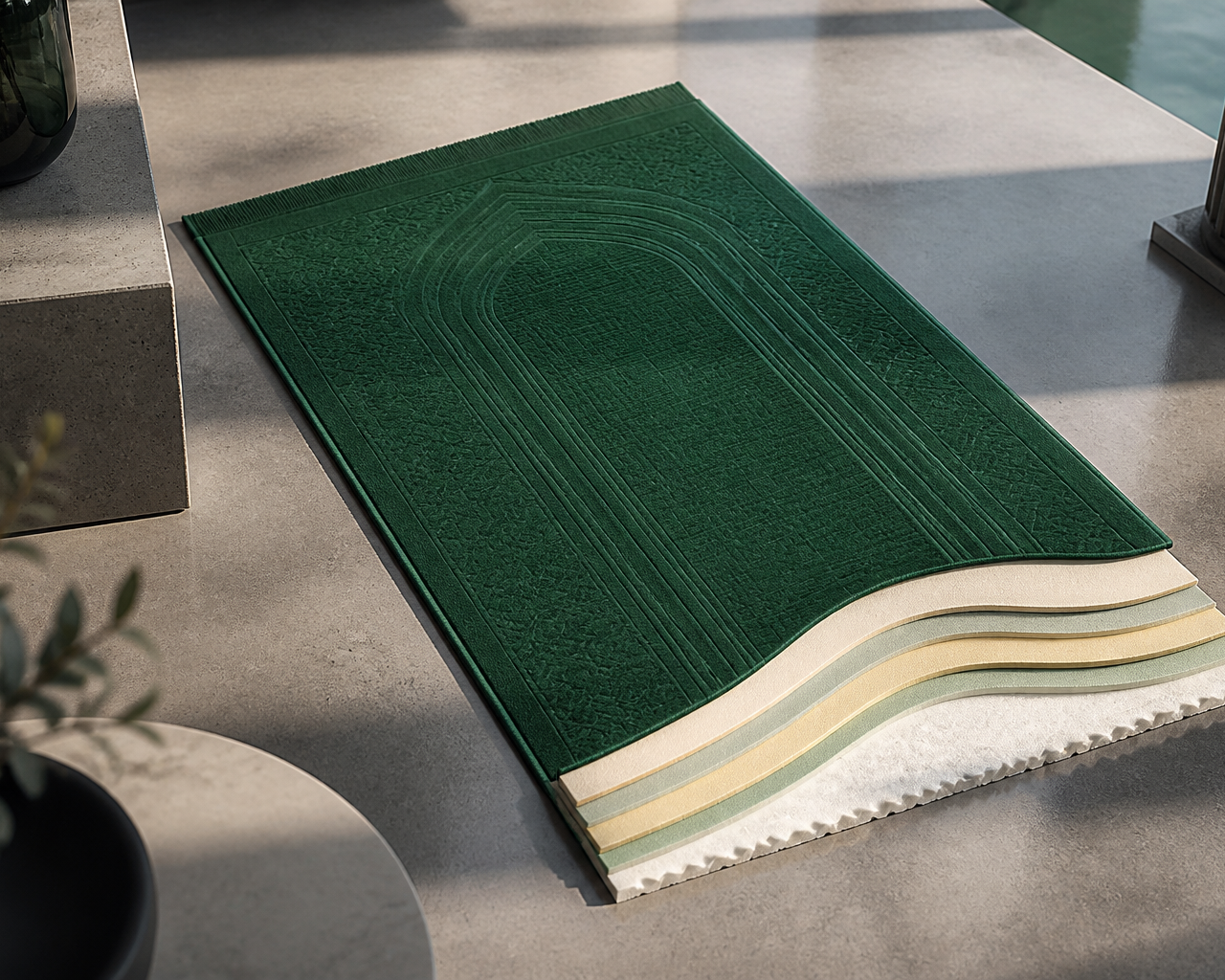
In a brightly lit studio in London’s Design District, a prototype lies across a mahogany table. It looks, at first glance, like a standard Sajjada—the traditional rug used by Muslims for daily prayers. But beneath its emerald-tinted wool surface lies a composite of high-density polymers and impact-reducing viscoelastic foam.
For centuries, the prayer rug has been a vessel for art, history, and theology. Yet, as the global Muslim population ages and the 'wellness' movement permeates every facet of life, a specific niche of industrial design is emerging: orthopedic spirituality. This isn't just about comfort; it is about the preservation of the body as a temple during the physical rigors of the Salah—a cycle of standing, bowing, and prostrating repeated multiple times a day.
The Physics of Prostration
When a practitioner enters Sujud (prostration), the weight of the body is distributed across seven contact points: the forehead, the palms, the knees, and the toes. In a standard thin-weave rug laid over a hardwood floor, the pressure intensity on the patella (kneecap) can exceed several times the body's resting weight.
Manufacturers like TIMEZ5 and MySalahMat have begun to treat this ritual not just as an act of faith, but as a biomechanical event. They are responding to a growing clinical reality: 'Prayer Knee,' a form of prepatellar bursitis caused by repeated friction and pressure on the knee joints.
"We are seeing a shift where practitioners no longer view physical discomfort as a badge of piety. The modern worshiper asks: How can my environment sustain my longevity in practice?" — Dr. Sarah Ahmed, Biomechanical Consultant
The Evolution of Materials: From Wool to Memory Foam
The transition from traditional materials to advanced composites has been controversial for some traditionalists, who argue that the 'humility' of the rug is lost. However, the data suggests a significant reduction in joint fatigue when using layered substrates.
Comparing Traditional vs. Ergonomic Rugs
| Feature | Traditional Kilim | Engineered Ergonomic Rug |
|---|---|---|
| Core Material | Woven Wool/Cotton | Multi-layered Memory Foam/Polymer |
| Pressure Absorption | Minimal (1-2mm) | High (15-25mm) |
| Surface Texture | Variable / Abrasive | Antimicrobial / Heat-sensitive |
| Portability | High (Rollable) | Moderate (Semi-rigid) |
| Primary Goal | Portability & Ritual Purity | Joint Protection & Alignment |
Why is the 'Smart Rug' Trending Now?
This phenomenon isn't happening in a vacuum. It sits at the intersection of several cultural shifts. First, the Global Islamic Economy is booming, with consumers seeking products that reflect a 'Modest-Modern' lifestyle. Second, the rise of bio-hacking has made people acutely aware of their posture even during meditative moments.
Designers are now integrating 'alignment markers'—subtle, aesthetically integrated geometric lines that guide the user’s foot and hand placement to ensure the spine remains neutral during the transition from Ruku (bowing) to Sujud.
The Impact of Substrate Density on Joint Longevity
Researchers at various sports science institutes have noted that the 'rebound rate' of a rug can affect how much energy the muscles must expend to stand back up. A rug that is too soft causes instability; a rug that is too hard causes micro-trauma. The 'Goldilocks' zone of rug density is currently the most competitive space in sacred industrial design.
The Aesthetics of the Invisible
How do you innovate on a product that has looked the same for 1,400 years? The answer lies in subtractive design. Top-tier designers are moving away from the busy, floral patterns of the 19th-century Persian style toward minimalist, architectural aesthetics that facilitate 'Kushu' (a state of focused humility).
- Monochromatic Textures: Using varying heights of pile to create patterns instead of distracting dyes.
- Antimicrobial Silver Ions: Weaving silver threads into the fabric to maintain hygiene in high-traffic prayer spaces.
- Heat-Responsive Layers: Foams that soften slightly upon contact with body heat, molding to the specific shape of the user's forehead and knees.
"The rug is the original 'portable sacred space.' By adding ergonomic science, we aren't changing the prayer; we are shielding the person praying from the distractions of their own physical limitations." — Omar Al-Maghribi, Industrial Designer
Comparative Analysis of Market Leaders
| Brand | Core Technology | Aesthetic Language |
|---|---|---|
| TIMEZ5 | NASA-inspired 5-layer system | Corporate / Minimalist |
| Mihrab Direct | High-density rebound foam | Traditionalist / Neo-Ottoman |
| Takva | Modular 'Pocket' inserts | Urban / Tech-wear |
Environmental and Ethical Considerations
As with all modern manufacturing, the shift toward polymers raises questions about sustainability. Can a memory foam rug be 'Halal' if it contributes to plastic waste? The next frontier in this niche is the development of bio-based foams—derived from algae or soy—to ensure the rug is as kind to the Earth as it is to the knees.
FAQ: Understanding the Ergonomic Ritual
Are ergonomic prayer rugs permissible (Halal) in Islamic tradition?
Yes. There is no theological prohibition against using tools that prevent injury or facilitate focus. In fact, preserving one's health (Hifz al-Nafs) is a core objective of Sharia law.
Who benefits most from these designs?
While originally marketed to the elderly or those with chronic joint pain, they are increasingly popular among office workers who spend all day sitting and athletes who require better recovery during their spiritual practices.
How do these rugs differ from standard yoga mats?
Yoga mats are designed for grip and full-body stretches, often lacking the specific localized cushioning required for the repeated impact of the knees and forehead found in Salah. Ergonomic rugs also maintain the specific dimensions and symbolic orientations required for the ritual.
The Future of Sacred Design
We are approaching an era where the environment adapts to the human, rather than the human straining to fit the environment. The ergonomic prayer rug is a testament to the fact that tradition is not a static artifact, but a living practice that breathes through the technology of its time. For the modern seeker, the path to the divine is now slightly more cushioned.
“We aren't changing the prayer; we are shielding the person praying from the distractions of physical limitation.”
Frequently asked questions
- What is 'Prayer Knee'?
- It is a form of prepatellar bursitis caused by repetitive contact with hard surfaces during ritual prostration, which ergonomic rugs aim to mitigate.
- Do ergonomic rugs affect the validity of the prayer?
- No. Most scholars agree that as long as the surface is clean and doesn't prevent the essential postures, the added comfort is acceptable and even encouraged for health.
- Are these rugs travel-friendly?
- While heavier than silk or wool rugs, new 'hybrid' models use collapsible foam cells specifically designed for commuters.