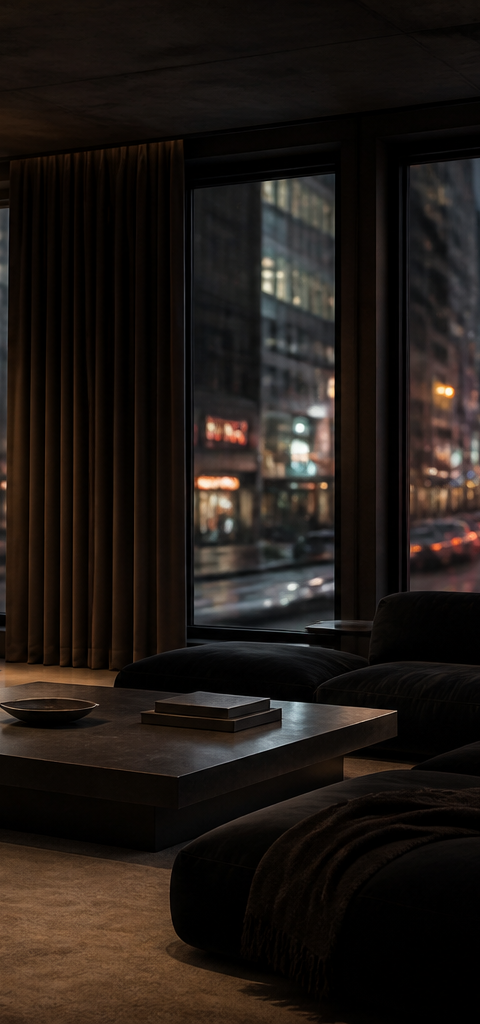
The Arbitrage of Quiet: The Secret Economy of Soundproof Real Estate
As urban density peaks, silence is evolving from a luxury amenity into a high-yield financial asset class.

The Roar of the Modern City
In the neon-soaked canyons of Manhattan or the glass-clad arteries of London’s City district, the air isn't just filled with smog; it is saturated with sound. For the modern urban professional, the background hum of HVAC systems, the staccato rhythm of sirens, and the low-frequency rumble of subway lines have become the white noise of survival. But for the astute investor, this sonic chaos represents something else entirely: a massive, untapped valuation gap.
We are entering an era where silence is the new gold. While traditional real estate metrics focus on square footage, proximity to transit, and natural light, a new generation of developers and private equity firms is betting that the most valuable square foot is the one you can’t hear. This is the Arbitrage of Quiet.
The Negative Externality of Noise
Economically speaking, noise is a classic negative externality. Unlike a physical eyesore, sound penetrates boundaries and impacts human capital directly. Studies by the World Health Organization (WHO) have linked chronic environmental noise not just to annoyance, but to cardiovascular disease, cognitive impairment in children, and a significant drop in workplace productivity. When productivity drops, so does the economic output of the space.
In the high-stakes world of New York real estate, a building located 50 feet from an elevated subway track typically trades at a 10% to 20% discount compared to its quieter counterparts. However, new construction methodologies are turning this discount into a premium. By utilizing Mass Timber, double-skin facades, and decoupled structural slabs, developers are creating "acoustic islands" that command rents significantly higher than their neighbors.
"Silence is no longer an absence of noise; it is a premium architectural product designed for the cognitive elite who require deep focus to generate value."
The Engineering of an Acoustic Premium
To understand the economics, one must understand the STC (Sound Transmission Class). Most standard residential walls in the U.S. have an STC rating of 33 to 35. At this level, loud speech is audible. High-end luxury developments are now pushing for an STC of 60 or higher, where even a shouting match next door is reduced to a faint murmur.
Why Investors are Pivoting to QuietTech
The financial logic is simple: Retention and Resilience. Residents who sleep better stay longer. Commercial tenants who can host sensitive board meetings without the intrusion of street noise are less likely to churn.
We can compare the traditional build vs. the acoustic-focused build in the table below:
| Feature | Standard Urban Development | Acoustic-Premium Development |
|---|---|---|
| Window Glazing | Double-pane (Standard) | Triple-pane Laminated (Vacuum-sealed) |
| Wall Assembly | Single Stud / Standard Batts | Staggered Stud / QuietRock / Green Glue |
| HVAC Design | High-velocity (Audible) | Variable Refrigerant Flow (Silent-spec) |
| Target STC | 35-40 | 60+ |
| Rent Premium | Baseline | +12% to +18% |
The Data Behind the Quietude
The market isn't just reacting to preference; it's reacting to health data. According to a landmark study by the European Environment Agency, noise causes 12,000 premature deaths annually in Europe alone. For a REIT (Real Estate Investment Trust), a building that promotes health is a building that qualifies for ESG (Environmental, Social, and Governance) funding.
Is Silence an Inflation Hedge?
As the world becomes louder—driven by increased delivery drone traffic, e-commerce logistics, and densification—the supply of truly quiet spaces is shrinking. Basic economics dictates that when supply shrinks and demand (from a stressed, remote-working population) increases, the price must rise.
- Urban Infill Opportunity: Buying low-value lots near noisy infrastructure (highways, rails) and applying advanced soundproofing to flip them into high-value residential units.
- Sound-as-a-Service: High-end coworking spaces like Industrious or Convene are increasingly marketing their acoustic privacy as their primary competitive advantage over home offices.
- The Rise of 'Quiet' Designates: Municipalities in Paris and Zurich are experimenting with noise-tax zones, essentially charging developers for the decibels their buildings emit—or rewarding them for mitigation.
"We aren't just selling a penthouse; we are selling the ability to hear your own thoughts in a world that never stops screaming."
Comparing Global Markets for Quiet
| City | Primary Noise Driver | Premium for 'Quiet' Property |
|---|---|---|
| Tokyo | Subway/Human Density | 8% - 12% |
| New York City | Sirens/Construction/Subway | 15% - 22% |
| London | Flight paths/Vintage Construction | 10% - 15% |
| Berlin | Hardwood acoustics/Traffic | 5% - 9% |
How to Invest in the Silence Trend
For the individual investor, the entry point isn't necessarily a 50-story tower. The Retrofit Market is booming. Companies like Indow (window inserts) and QuietRock are seeing double-digit year-over-year growth. Investing in the materials science behind sound dampening is a peripheral play on the real estate market without the overhead of physical property management.
Can you realmente 'Price' Silence?
Critics argue that silence is subjective. What one person finds peaceful, another finds eerie. However, the market clearing price of sound-dampened units suggests otherwise. In the 2023 luxury residential report, properties featuring "enhanced acoustic privacy" saw a 30% faster time-to-sale than those without, even when adjusted for price-per-square-foot.
FAQ: The Economics of Acoustic Real Estate
Does soundproofing actually increase property value?
Yes. Appraisers are increasingly looking at "environmental quality" metrics. In dense urban markets, documented acoustic mitigation can add 5% to 15% to a property's resale value compared to identical units in the same zip code.
Is it better to renovate or buy new for silence?
Renovating for silence is expensive due to the need to 'decouple' walls. It is often more cost-effective to buy into new developments where soundproofing was integrated into the structural slab and HVAC design from day one.
What are the best materials for soundproofing an investment property?
Look for Mass Loaded Vinyl (MLV), triple-pane windows with diverse glass thicknesses to break different frequencies, and decoupling channels that prevent sound vibrations from traveling through the building's skeleton.
“The most valuable square foot in the modern city is no longer the one with the view, but the one you can’t hear.”
Frequently asked questions
- How much does professional soundproofing add to construction costs?
- High-level acoustic engineering typically adds 3% to 5% to total construction costs but can yield a 15%+ increase in rental income or resale value.
- Can thermal insulation serve as soundproofing?
- Partially, but they are not the same. Thermal insulation stops heat transfer; soundproofing requires 'mass' to stop airborne noise and 'decoupling' to stop structural vibrations.
- Which cities have the highest premium for quiet real estate?
- New York City and London currently lead, where the 'noise discount' for unmitigated properties is most severe, creating the largest arbitrage for developers.