The Ghost in the Machine: Why We Are Addicted to Mutual Monitoring
Beyond the 'seen' receipt lies a complex web of digital surveillance that is quietly reshaping the biological foundations of trust and intimacy.
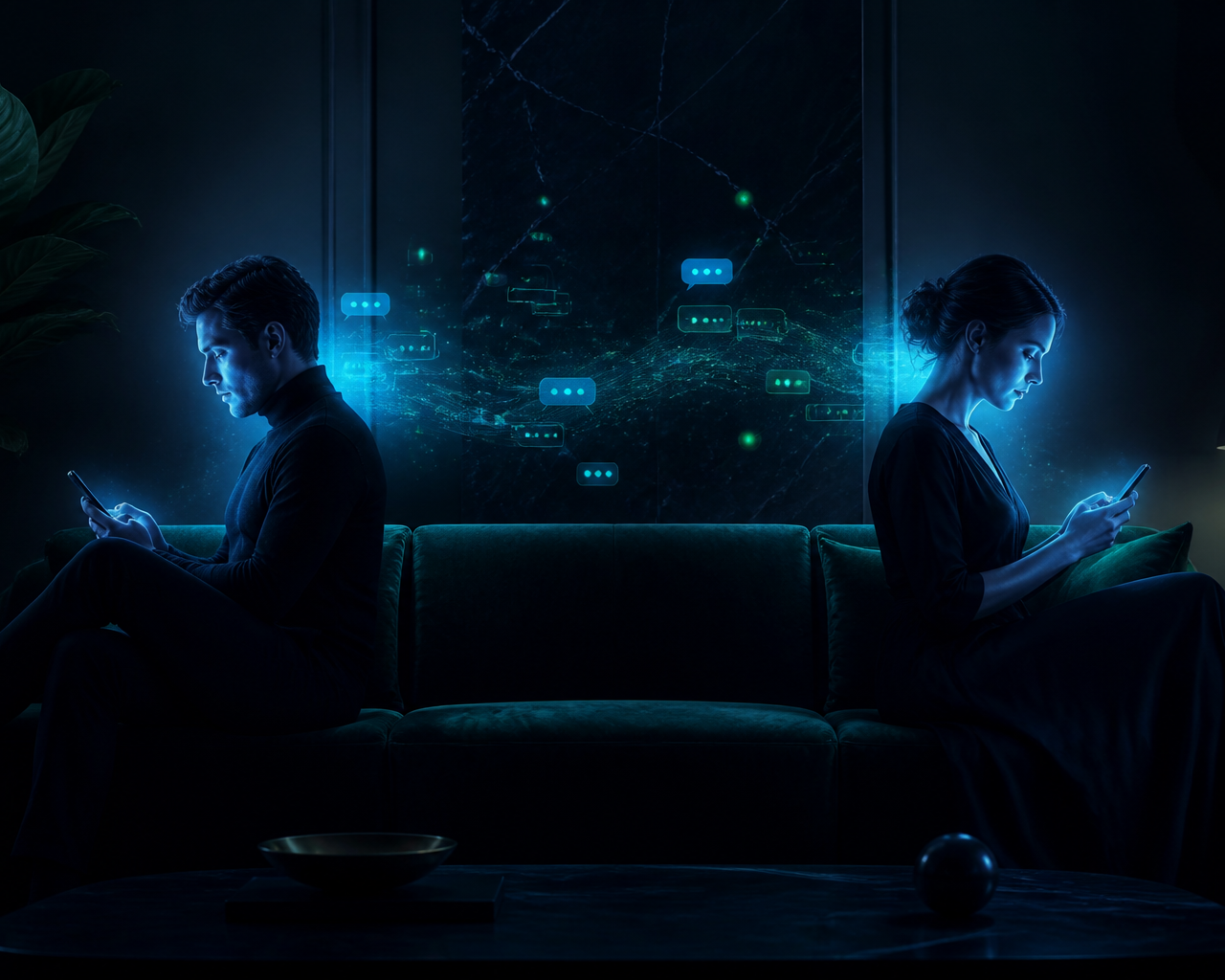
The Midnight Inventory of the Heart
It is 2:14 AM on a Tuesday, and Sarah is performing a ritual familiar to millions, yet spoken of by few. She isn’t checking the news or setting an alarm. Instead, she is scrolling through the 'Active Status' indicators on three different platforms. She is looking for a green dot—a digital heartbeat—belonging to a man she has been dating for exactly six weeks.
This isn't stalking in the traditional, predatory sense. It is what sociologists are beginning to call Mutual Monitoring: a state of low-level, continuous digital surveillance that has become the default setting for modern intimacy. We aren't just dating people anymore; we are dating their data streams.
In the era before the smartphone, absence was absolute. When a lover left the room, they entered a black box of unreachability. Today, the 'Black Box' has been replaced by a glowing screen that offers a deceptive illusion of presence. We can see when they were last online, what they liked on Instagram, and whether they are currently typing a message that may never be sent. This persistent connectivity is not just a convenience; it is a fundamental rewiring of our attachment systems.
Is Digital Monitoring Ruining Our Relationships?
To understand why we can’t stop checking, we have to look at the Dopamine-Cortisol Loop. Every time we see a 'Seen' notification, our brain registers a hit of information. If that information confirms our safety (e.g., they replied quickly), we get a hit of dopamine. If it contradicts our expectations (e.g., they are active on Instagram but haven't texted back), our amygdala triggers a stress response.
The Spectrum of Digital Transparency
Not all digital monitoring is created equal. We must distinguish between consensual transparency and compulsive surveillance.
| Feature | Purpose | Psychological Impact |
|---|---|---|
| Read Receipts | Confirmation of receipt | High anxiety; 'obligatory' response pressure |
| Location Sharing | Safety and logistical ease | Paradoxical loss of autonomy; 'digital tethering' |
| 'Active Now' Status | Availability signaling | Induced jealousy; hyper-vigilance about 'ignored' time |
| Shared Calendars | Coordination | High efficiency; loss of mystery and 'missing' someone |
"The problem isn't that we know too much; it's that we know just enough to misinterpret everything. We are attempting to read a person's soul through the metadata of their battery percentage."
The Neurobiology of the 'Seen' Receipt
When you see those three bouncing dots signifying a reply is being drafted, your brain enters a state of anticipatory arousal. According to research published in the Journal of Computer-Mediated Communication, the delay between 'Seen' and 'Replied' is the new frontier of relational power dynamics. This 'liminal space' creates a vacuum that we fill with our deepest insecurities.
In a healthy relationship, trust acts as a buffer. In an anxious-attached relationship, digital markers become a scoreboard. We are seeing a rise in 'Digitally Mediated Jealousy', where the lack of an immediate response is interpreted as a withdrawal of affection.
The Cost of Hyper-Visibility
Historically, relationships thrived on the tension between togetherness and separateness. Today, that tension is being flattened.
- The Loss of the Narrative: We no longer have to ask "How was your day?" because we saw their lunch on a Story and their complaints on X (formerly Twitter).
- The Collapse of Context: We see them 'Active' but don't know they are in a high-stress meeting using their phone as a hotspot.
- The Persistence of the Past: We are the first generation that never truly has to say goodbye. Exes remain 'zombified' in our feeds, their metadata haunting our present.
How Common is Digital Surveillance in Couples?
As shown in recent studies, the vast majority of young adults engage in some form of 'soft' monitoring. The shift from 'checking in' to 'checking up' is often invisible to the participants until a conflict arises.
Comparing Healthy vs. Toxic Digital Habits
| Habit | Healthy Expression | Potential Red Flag |
|---|---|---|
| Location Sharing | Used for safety during travel or late nights. | Used to cross-reference location against reported activity. |
| Social Media | Celebrating each other's milestones publicly. | Monitoring followers/likes to 'detect' third-party threats. |
| Device Access | Knowledge of passcodes for emergencies. | Regular, unprompted 'sweeps' of private messages. |
| Response Time | Respecting work hours and social absences. | Requiring explanations for gaps in communication. |
Reclaiming the 'Right to be Missed'
How do we break the cycle? The answer lies in Digital Boundaries. Just as we establish boundaries around physical space and emotional labor, we must establish a 'Digital Pre-Nup' of sorts.
"Privacy is not the same as secrecy. Secrecy is withholding the truth to deceive; privacy is the sacred space required for an individual to remain an individual within a pair."
Strategies for Digital Wellness in Love
- The 24-Hour Buffer: Agree that non-urgent texts do not require an immediate response. Turn off 'Last Seen' indicators to lower the stakes.
- Scheduled Absence: Practice 'monk mode' together where phones are placed in a different room for two hours a night.
- The Context Rule: If you feel a surge of anxiety from a digital marker, call the person instead of spiraling. The human voice contains 90% more nuance than a 'Like'.
Frequently Asked Questions (FAQ)
Does turning off read receipts make me look suspicious?
Not necessarily. It characterizes a boundary for your own mental health. Openly communicating to your partner that you find 'Seen' receipts anxiety-inducing framing it as 'self-care' rather than 'hiding something' is key.
Is location sharing a sign of a healthy relationship?
It depends on the motivation. If it provides peace of mind for safety, it is a tool. If it is used to 'verify' a partner's words, it indicates a fundamental lack of trust that GPS cannot fix.
How do I stop 'doom-scrolling' my partner's activity?
Practice Mindful Delay. When the urge to check their status hits, wait ten minutes. Often, the spike of cortisol will subside, allowing the rational prefrontal cortex to take back control from the impulsive amygdala.
The Path Forward: Towards Conscious Connectivity
We are currently in the 'adolescence' of digital intimacy. We have tools that our biology isn't quite ready for. The goal isn't to return to the stone age of landlines, but to develop a Sophisticated Digital Etiquette. By prioritizing the human connection over the data stream, we can ensure that the 'Ghost in the Machine' doesn't become the third person in our marriages.
Ultimately, the strongest signal in any relationship isn't a 5G connection or a green dot—it is the quiet, analog confidence that when you reach out, the other person will eventually reach back, regardless of what the metadata says.
“We aren't just dating people anymore; we are dating the shifting metadata of their digital existence.”
Frequently asked questions
- What is mutual monitoring in relationships?
- It is the continuous, often unconscious tracking of a partner's digital 'breadcrumbs,' such as social media likes, active status, and location, to maintain a sense of connection or security.
- Can digital transparency harm intimacy?
- Yes, by removing the 'tension' of absence and the need for verbal storytelling, hyper-visibility can lead to a loss of mystery and individual autonomy.
- How can couples reduce digital anxiety?
- Couples can disable 'read receipts' and 'last seen' markers, and establish clear expectations about response times for non-urgent messages.