The Silicon Sommelier: Why AI is Rewriting the Chemistry of Taste
Molecular profiling and predictive algorithms are transforming the beverage industry from an art of intuition into a precise data science.
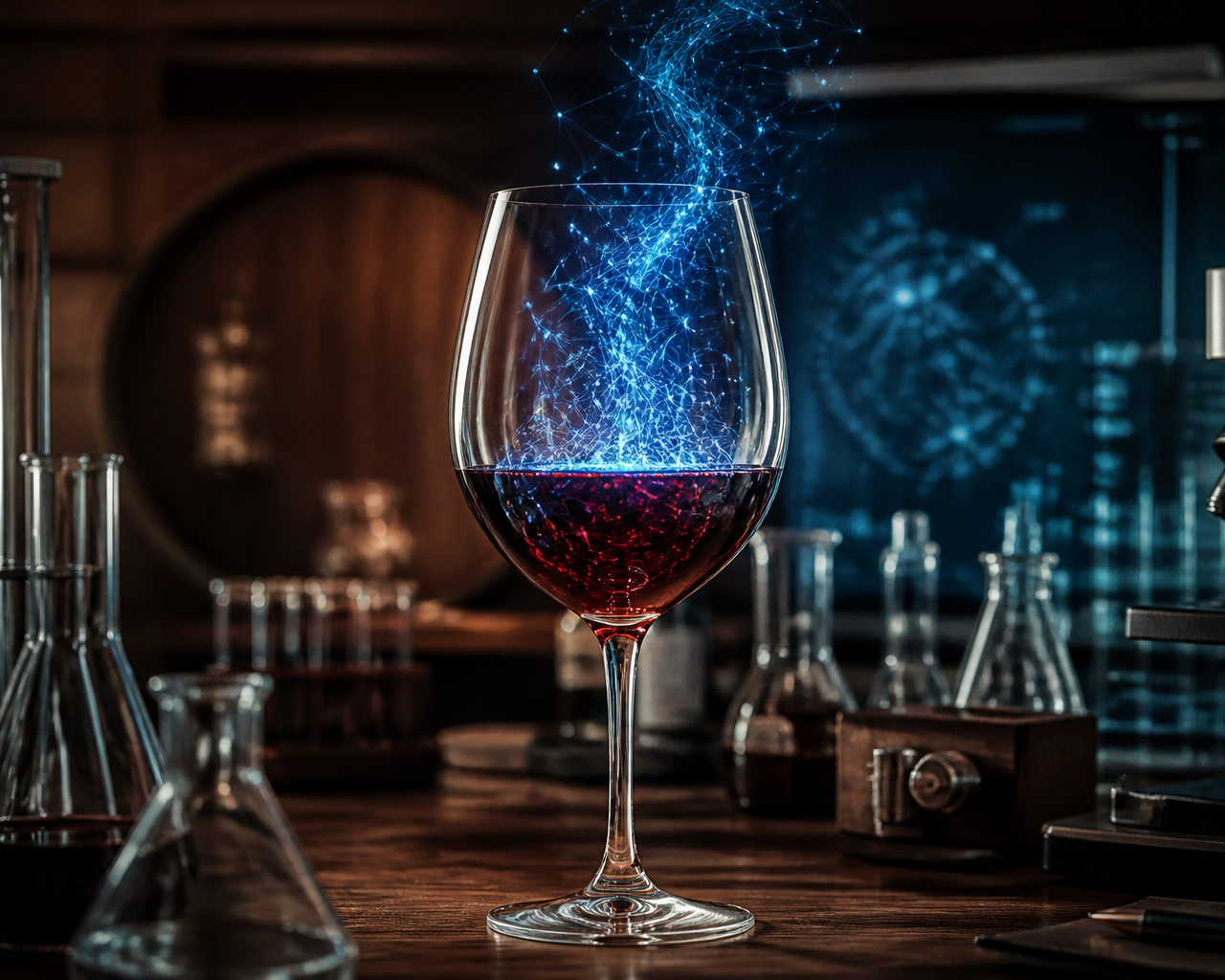
The Ghost in the Glass
In a dimly lit laboratory in Copenhagen, a mechanical arm swirls a glass of Cabernet Sauvignon. There is no nose to sniff the bouquet, no palate to weigh the tannins. Instead, a series of sensors—an electronic tongue—dissects the liquid into a digital fingerprint of polyphenols, esters, and volatile organic compounds. Within seconds, a nearby monitor displays a predictive score: the likelihood that a female consumer in her mid-30s in Tokyo will enjoy this specific vintage.
We are entering the era of the Silicon Sommelier. For centuries, the creation of flavors was a romantic, often erratic pursuit led by master blenders and seasoned chefs. Today, the billion-dollar beverage industry is pivoting toward a paradigm where AI doesn't just assist the creator, but dictates the blueprint of taste itself. By analyzing the molecular structure of thousands of successful products, machine learning models are identifying the precise chemical 'hooks' that trigger pleasure in the human brain.
Can AI Truly Understand Human Taste?
The fundamental challenge of flavor is subjectivity. What one person describes as 'earthy,' another might find 'bitter.' However, companies like Givaudan and startups like Gastrogon are betting that while perception is subjective, chemistry is absolute. By mapping the flavor network—the complex web of chemical compounds that different foods share—AI can suggest pairings that seem counterintuitive to a human but are molecular matches.
The Rise of Molecular Profiling
Traditionally, a new soda or whiskey would undergo months of focus group testing. This process is notoriously flawed; humans are poor at articulating why they like what they like. AI removes the guesswork. Modern platforms use Natural Language Processing (NLP) to scrape millions of social media reviews, cross-referencing them with proprietary gas chromatography data.
"We aren't just making a better drink; we are decoding the biological response to flavor. The goal is to reach a level of personalization where a beverage can be tuned to an individual's unique genetic sensitivity to bitterness."
Tables of Influence: Machine vs. Human
To understand the shift, we must look at how AI-driven development differs from the traditional R&D cycle. The speed of iteration is the most jarring change.
| Feature | Traditional R&D | AI-Driven Formulation |
|---|---|---|
| Development Time | 12 - 24 Months | 4 - 8 Weeks |
| Sample Size | Hundreds of Focus Groups | Millions of Data Points |
| Risk Profile | High (50-80% Failure Rate) | Low (Predictive Success Models) |
| Primary Tool | Human Palate | Neural Networks/LC-MS |
The Democratization of the 'Perfect' Flavor
This shift isn't just for luxury wines. The most significant impact is occurring in the functional beverage and plant-based sectors. For instance, the challenge of making pea protein taste like dairy or lab-grown meat mimic the savory 'umami' of a steak is a mathematical problem. AI identifies the specific molecules—heterocyclic compounds and alkenals—needed to bridge the gap.
Comparing Approaches to Flavor Science
| Methodology | Mechanism | Primary Application |
|---|---|---|
| Sensory Science | Human panels and blind taste tests | Consumer packaged goods/Sodas |
| Molecular Archeology | Recovering lost yeast strains via DNA | Craft beer and heirloom spirits |
| Generative Flavor AI | Synthesis of new chemical combinations | Plant-based meat & functional food |
How AI Solves the 'Newness' Problem
Consumer fatigue is the enemy of the modern food conglomerate. A brand like Coca-Cola or Diageo must balance nostalgia with the constant demand for novelty. AI excels here by performing trend forecasting. By analyzing regional shifts in ingredients—say, the rising popularity of Yuzu in North American cocktail bars—AI can suggest flavor extensions before the trend even hits the mainstream.
However, this raises an existential question: Does the rise of the machine mean the end of the artisan? While some fear the homogenization of taste, proponents argue that AI is merely a tool that handles the 'drudge work' of chemistry, allowing creators to focus on the storytelling and brand identity that no algorithm can replicate.
"The algorithm can tell me that a certain concentration of vanillin will sell. It cannot tell me the story of the oak barrel or the history of the soil. That remains the human element."
The Ethical Implications: Engineering Addiction?
As AI becomes more adept at hitting our neurological 'sweet spots,' a darker concern emerges. If software can design the 'perfect' snack, could it also design one that is biologically impossible to resist? The line between 'satisfying' and 'hyper-palatable' is thin. Regulatory bodies are already beginning to look at how these high-precision formulations might contribute to the global obesity crisis by overriding the body's natural satiety signals.
FAQ: Understanding AI in Food and Beverage
Q: Is AI actually making the drinks, or just recommending recipes? A: Currently, AI acts as a co-pilot. It generates the chemical formulation based on a set of parameters (e.g., 'refreshing,' 'no sugar,' 'fruity'). Human chemists then produce the samples, though some pilot plants are now using robotics to automate the mixing process.
Q: Will this make all food taste the same? A: Paradoxically, it might do the opposite. AI allows for extreme localization, enabling brands to tweak a single product for the specific taste preferences of different cities or demographics without skyrocketing costs.
Q: How does AI know what people like? A: It combines 'implicit' data (molecular structure and chemical receptors) with 'explicit' data (historical sales, social media sentiment, and demographic surveys).
Conclusion: The New Alchemy
The future of flavor isn't in a cookbook; it’s in a server rack. As we refine the interface between biological sensors and digital processing, the products we consume will become more efficient, more personalized, and undeniably more scientific. The silicon sommelier doesn't replace the human heart of the culinary world—it simply ensures that every drop poured is closer to the ideal of what we crave.
SEO Keywords: AI flavor development, food technology trends 2024, molecular beverage science, predictive taste algorithms, future of food manufacturing.
“We are no longer just making a drink; we are decoding the biological response to flavor itself.”
Frequently asked questions
- What is an electronic tongue?
- It is a sensor-based system that uses electrochemical signals to identify the specific flavor components—sweet, sour, bitter, salty, and umami—within a liquid.
- Does AI replace humans in the recipe-making process?
- No, it acts as a high-speed research assistant that filters through billions of chemical combinations to suggest the most viable recipes for humans to refine.
- How is AI used in the wine industry specifically?
- Wineries Use AI to analyze soil conditions, grape maturity, and historical critic scores to optimize the fermentation process and predict market success.